Explain Different Types of Cohesion in Software Engineering
Different than logical cohesion because functions not intertwined. Each part necessary for execution of a single function.
Software Engineering Coupling And Cohesion Geeksforgeeks
The greater the cohesion the better is the program design.
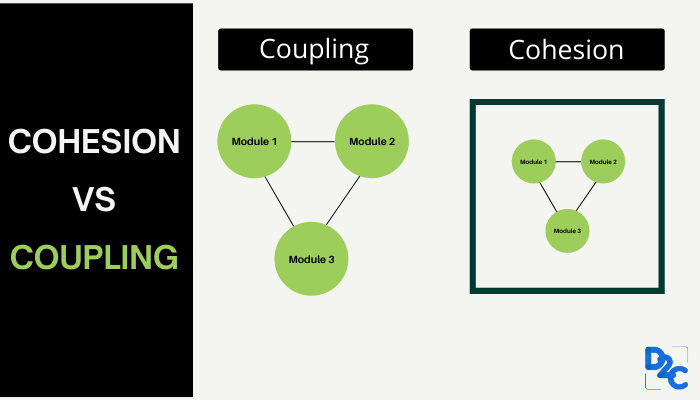
. Usually reusable in other contexts. Modules with high cohesion tend to be preferable because high cohesion is associated with several desirable traits of software including robustness reliability reusability and understandability. Software engineering methods provide the technical aspects for building software.
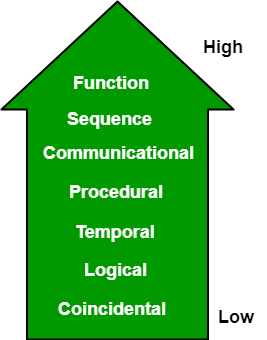
There are seven types of cohesion namely Co-incidental cohesion - It is unplanned and random cohesion which might be the result of breaking the program into smaller modules for the sake of modularization. For example consider booting a computer requires several functions to be performed like loading memory operating systems etc. There are different software development life cycle models specify and design which.
Common Coupling consists of the modules that share the overall constraints in the midst of any two modules of the software system. Because it is unplanned it may serve confusion to the programmers and is generally not-accepted. Types of Cohesion in Software Engineering 1.
Not strictly a linear scale. It is a culture that ultimately leads to the development of software engineering. Types of Modules Cohesion Functional Cohesion.
Cohesion is an ordinal type of measurement and is usually described as high cohesion or low cohesion. Cohesion represents the degree to which a part of a code base forms a logically single atomic unit. Explain thedifferent types of cohesion that a module might exhibit.
Software Development life cycle SDLC is a spiritual model used in project management that defines the stages include in an information system development project from an initial feasibility study to the maintenance of the completed application. There are 8 types of cohesion. Functional CohesionSequential CohesionCommunicational CohesionProcedural CohesionTemporal CohesionLogical Cohesion and Coincidental Cohesion It is not possible to achieve no coupling among all modules.
What is couplingand cohesion in reference to software design. A module is said to have coincidental cohesion if it performs a set of function or tasks that relate to each other very loosely. Learn more about these basic types of software design including abstraction patterns segregation of data modularity data hiding.
If the module contains functions that are related by facts that these functions are executed in same time span then the module is said to possess temporal cohesion. Types of Cohesion. In software engineering there are seven main design concepts.
Cohesion represents the functional strength of modules. Eg compute square root or sort the array. Increasing in coupling is avoided for software.
Increasing in cohesion is good for software. A module is said to possess sequential cohesion if the element of a module form the components of. In this case the module contains a random collection of functions.
Its a perfect scenario. Software engineering methods rely on the set of modeling activities and other descriptive techniques. In contrast low cohesion is.
Methods encompass a broad array of tasks that include communication requirements analysis design modeling program construction testing and support. This also can be a sign of any change made in the common constraint will reflect in the modules that share the common coupling scenario. The different classes of cohesion a module may possess include.
Because it is unplanned it may serve confusion to the programmers and is generally not-accepted. Is it true thatwhenever we increase the cohesion of different modules in our design couplingbetween these modules automatically decreases. Functional Cohesion is said to exist if the different elements of a module cooperate to achieve a.
What You Need To Know About Cohesion. If a single module aims to perform all the similar types of functionalities through its different elements then the module is said to exhibit functional cohesion. Modules that support a data abstraction.
Cohesion represents the relationship within module. The execution of the task related to the problem is the only concern from all the elements. The component contains all of the necessary elements for a single computation.
The job and functions are carried out by a functional cohesion. Answer - 1 Different types of cohesion are as follows. Coupling represents the relationships between modules.
Coupling is the concept of inter module. There are four types of layers in Software Engineering such as Tools methods process A quality focus. There are seven types of cohesion namely Co-incidental cohesion - It is unplanned and random cohesion which might be the result of breaking the program into smaller modules for the sake of modularization.
In the sequential cohesion the different elements of a module form a series in which the output of one element treats as an input to the other elements. How are these concepts useful inarriving at a good design of a system. The data which is the output of one activity is used an input data for the next activity the.
The different classes of cohesion that a module may possess are shown in Fig. The bedrock that supports software engineering it says A quality focus.

Cohesion In Software Engineering Amazing Advantages Of Cohesion
Difference Between Cohesion And Coupling Unstop
Software Engineering Coupling And Cohesion Geeksforgeeks
0 Response to "Explain Different Types of Cohesion in Software Engineering"
Post a Comment